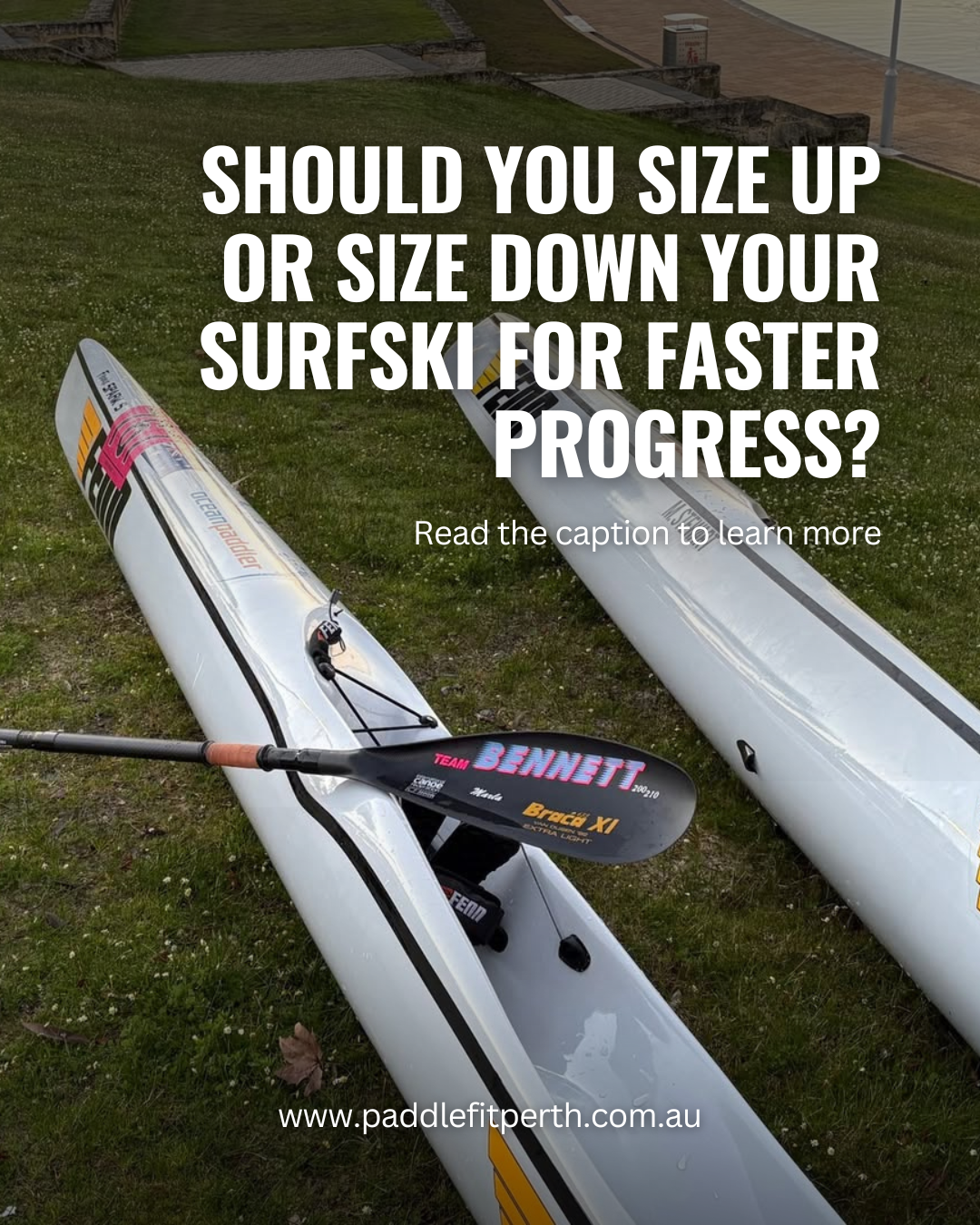
Should You Size Up or Size Down Your Surfski for Faster Progress?
Few topics create quieter tension in the surfski world than boat progression.
When is it time to move into a narrower, faster ski?
And does upgrading too early actually slow your development?
Every paddler seems to have a strong opinion.
Some believe you should paddle the most stable ski possible for as long as possible. Others argue that stepping into a narrower boat forces adaptation and accelerates growth.
Like most debates in performance sport, both sides are shaped by experience.
Let us unpack it.
The Argument for Staying in a More Stable Surfski
Stability Builds Skill
If you are bracing constantly, you are not working on technique. You are surviving.
A stable ski allows you to:
• Apply full power without hesitation
• Focus on clean catch and rotation
• Practice linking runs without fear
• Relax in messy cross chop
Relaxation is not talked about enough in surfski paddling. When your nervous system is calm, your movements become smoother. You conserve energy. You read water better.
In typical Perth sea breeze conditions, where short period wind swell can create unpredictable texture, tension is expensive. A stable boat allows experimentation.
Confidence Equals Consistency
Progress in surfski is built on time in the seat.
If your boat choice makes every session stressful, you are less likely to paddle in marginal conditions. You will avoid windier days. You will hesitate when boat wakes hit.
Consistency suffers.
Many coaches argue that a paddler who feels confident will accumulate more quality sessions over a year than one who constantly feels on edge in a tippy ski.
And over time, accumulated quality work wins.
The Argument for Moving Into a Narrower Ski
Adaptation Requires Challenge
There is another perspective.
If you never challenge your stability ceiling, it will not rise.
A slightly narrower ski demands better posture, cleaner weight transfer, and more precise leg drive. It exposes asymmetries you may not notice in a wide hull.
Some paddlers report dramatic improvements in balance after forcing adaptation in a narrower boat.
The key word there is slightly.
Glide Changes the Game
In moderate downwind conditions, narrower skis often hold glide more effectively between bumps. That extra carry can make linking runs feel smoother once stability is dialed in.
For advanced paddlers in lighter wind days, where acceleration is crucial, the responsiveness of a performance ski can unlock speed that a wider hull simply cannot provide.
But this only works if the paddler is relaxed enough to use it.
The Hidden Cost of Ego
There is also a reality that rarely gets discussed openly.
Boat choice can be influenced by ego.
Paddlers want to feel like they are progressing. A narrower ski looks like advancement. It signals improvement.
But the ocean does not care what model you are paddling.
If downsizing leads to tension, missed runs, frequent swims, or reduced training volume, performance may plateau rather than improve.
The fastest paddler in the group is often not the one in the narrowest boat. It is the one extracting the most from the boat they are in.
The 4 Percent Rule
In performance psychology, growth often happens when challenge slightly exceeds skill.
Not 20 percent beyond your ability. Not survival mode.
Just enough instability to demand focus without triggering fear.
If your current ski feels completely effortless in all conditions, perhaps you are ready for more challenge.
If your heart rate spikes every time side chop appears, perhaps you are not.
The sweet spot is individual.
So When Should You Size Up or Size Down?
Instead of asking what the fastest paddlers are using, ask:
Are you relaxed in 90 percent of the conditions you train in?
Can you apply full power without bracing?
Do you avoid certain wind directions because of stability?
Are you swimming more than you are learning?
For surfski paddlers training along the Western Australian coastline, where wind strength and water texture vary dramatically, boat choice should match both skill and environment.
Progression is not about the narrowest ski you can survive in.
It is about the fastest ski you can truly perform in.
Perhaps the real debate is not stable versus elite.
It is this.
Are you choosing a boat that builds your long term performance, or one that satisfies short term pride?
That is a conversation worth having.
Ready to make the right move for your paddling?
Join us at Paddle Fit Perth for a session and get expert feedback on your technique, stability, and boat choice so you can progress with confidence.
Train smarter. Paddle stronger.